Posts

Showing posts with the label Travel Photography

Travel Photography 4
Image
Over the years I used Nikon SLR cameras to shoot photos. Nikon cameras are good for taking fine colours and texture. Once one has got it, it is difficult to switch brands. Switching brands necessitates buying new camera and lens. Investment on good lens can be higher than the camera. Canon's edge is speed. It's the choice of most sports reporters. Details, texture and colours are shown optimally with Nikon D70 Camera, Nikon 24-70mm and Tokina 80-200mm lens. The best handy lens fitting most occasions is 28-70mm. It's good for taking landscape photos. I moved into digital photography in 2004. With the smaller framing constraint, 18 - 55mmis a better choice of wide angle lens. With the advance of technology, a lot of automatic digital cameras can achieve very good photo quality. I owned two. Samung L700 and Fujifilm F70 EXR acquired in 2006 and 2009. F70 EXR comes with 10x Optical Dual Image Stabilized Zoom and 2.7 inch LCD. It can take quality pictures in extreme s...
Travel Photography 3

Image
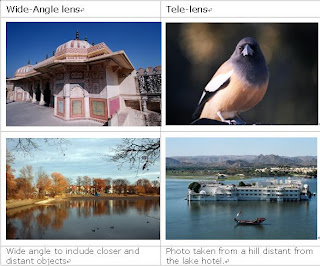
Shutter Speed Shutter is a small plastic sheet that opens and closes to allow light onto the film/sensor or prevent light from reaching the film/sensor. Shutter speed controls the amount of time that your film/sensor, is exposed to light. It is measured in fractions or units of seconds. The lighter the environment, the shorter the time the shutter is needed to open for the light to reach the film or sensor, e.g. 1/250, 1/1000. When it gloomy, a slower shutter speed is required to maximise the time for the light to reach the film/sensor, e.g. 1/30, 1 second. Focal Length / Lens The focal length of a lens determines how much the subject will be magnified or distant. Lens are categorised as standard, wide-angle and tele. Standard lens is 50mm. It does not magnify or distant a subject. Wide-angle lens allows to take lots of things into the framing of a photo. It stretches the perspective and make the object closer to the len look bigger. Wide angel lens start from 10 and...

Taking Great Photos 2

Image
Basics of Photography: Light / Exposure - the subject should face the light source - exposure compensation / ISO to adjust the strength of light Click the image to magnify it. Composition Metering Centre-weighted and Multi-zone are the common metering methods.  The previous assigns the greatest weight of metering to the centre of the frame.  The latter measures the light density of various zones, combines the results to find the best metering.  Normally, I take multi-zone.  When contrast of light is emphasised, I will switch to the centre-weighted mode. Aperture Aperture controls the amount of light entering into the camera.  One can adjust the aperture if aperture-mode is available or at manual exposure mode.  It ranges from 1.4 to 32.  The lower the numeric the bigger amount of light can be taken for shooting.  References: Kindle version with big savings is available! No theory, jargon or complicated concep...

Taking Great Photos 1

Image
Taking great photos is not a privilege of professional photographers. You and I, whether with an automatic or high end camera, can do it. Photography is communication. It conveys what you see to the audiences. A good photo gets people’s attention because it tells a story, invites imagination, delights, freezes the moment of beauty, memories….. Once or twice a year, I take photos when I travel. I acquire basic photography knowledge by reading, seeing others’ photos and practice. Before taking a photo, think yourself what you want to communicate, record. A purpose helps shooting great photos. Then consider the light source, composition, perspective and focal length. Most cameras optimise the combination of aperture and shutter speed well. Unless you aim for special effects, you can let the camera do its job. It’s a pleasure to share some basics and tips for taking photos. Photography is..... - Memory / Reporting - Creativity / Art - Communication Essence of taking great ph...